
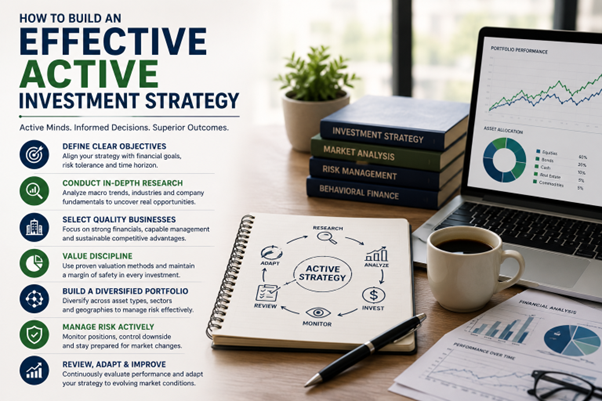
How to Build an Effective Active Investment Strategy
Active investing is built on the principle that disciplined research, strategic decision-making, and market insight can outperform passive market tracking over time. We believe that successful investing requires more than simply following benchmarks; it demands a proactive approach focused on identifying opportunities, managing risks, and adapting to changing market conditions.
An experienced activist investor often demonstrates how strategic engagement, detailed analysis, and long-term conviction can create substantial shareholder value. By studying market inefficiencies and company fundamentals, investors can uncover opportunities that may not yet be recognised by the broader market.
A strong activist investment strategy is rooted in deep research, active portfolio management, and a willingness to challenge conventional market assumptions. This approach enables investors to capitalise on undervalued assets, operational inefficiencies, and emerging industry trends while maintaining flexibility in dynamic market environments.
Defining Clear Investment Objectives
The first step in building an effective active investment strategy is establishing clear and measurable objectives. Every investment decision should align with specific financial goals, risk tolerance levels, and time horizons.
These objectives may include:
- Long-term capital appreciation
- Income generation through dividends
- Portfolio diversification
- Preservation of capital during volatile market conditions
Without defined goals, investment decisions can become inconsistent and reactive. A structured framework ensures discipline and helps investors maintain focus during periods of market uncertainty.
Conducting Comprehensive Market Research
Research forms the backbone of active investing. We rely on detailed analysis to identify opportunities that the broader market may overlook.
Macroeconomic Analysis
Understanding economic conditions is essential for evaluating investment opportunities. Important factors include:
- Interest rate trends
- Inflation levels
- Currency movements
- Fiscal and monetary policies
These indicators influence corporate profitability, consumer behaviour, and overall market sentiment.
Industry and Sector Evaluation
Certain sectors outperform during different economic cycles. Evaluating industry dynamics allows investors to identify:
- Growth industries with strong demand drivers
- Sectors benefiting from technological disruption
- Industries vulnerable to structural decline
A sector-focused approach enhances the ability to allocate capital strategically.
Identifying High-Quality Companies
Successful active investing depends on selecting companies with strong fundamentals and sustainable competitive advantages.
Financial Strength
We evaluate businesses based on:
- Revenue growth consistency
- Profit margins
- Cash flow generation
- Debt management
Companies with strong financial foundations are generally more resilient during economic downturns.
Management Quality
Leadership quality significantly impacts long-term performance. Strong management teams typically demonstrate:
- Clear strategic vision
- Effective capital allocation
- Transparency and accountability
Companies led by capable executives are better positioned to adapt to market changes and create shareholder value.
Competitive Advantages
Businesses with durable competitive advantages often maintain stronger profitability over time. These advantages may include:
- Brand recognition
- Proprietary technology
- Efficient supply chains
- Market leadership in niche industries
Developing a Disciplined Valuation Approach
Even excellent companies can become poor investments if purchased at excessive valuations. A disciplined valuation framework helps investors avoid overpaying and improves long-term returns.
Common Valuation Metrics
We use multiple methods to determine intrinsic value, including:
- Price-to-earnings ratios
- Price-to-book ratios
- Discounted cash flow analysis
- Enterprise value to EBITDA comparisons
Margin of Safety
Investing with a margin of safety provides protection against unexpected risks or forecasting errors. Purchasing undervalued assets reduces downside exposure while increasing upside potential.
This disciplined approach is especially important during periods of heightened market optimism when valuations may become detached from fundamentals.
Building a Diversified Portfolio
Portfolio construction is critical to balancing risk and return. Effective diversification reduces the impact of individual investment losses while maintaining exposure to growth opportunities.
Diversification Across Asset Types
A well-structured portfolio may include:
- Large-cap growth stocks
- Mid-cap expansion companies
- Defensive sectors for stability
This balance enhances resilience during market fluctuations.
Sector Diversification
Avoiding excessive concentration in a single industry helps mitigate sector-specific risks. Exposure across multiple sectors creates a more balanced return profile.
Geographic Diversification
Global diversification reduces reliance on a single economy and provides access to broader opportunities across international markets.
Implementing Strong Risk Management Practices
Risk management is essential for preserving capital and sustaining long-term performance. Active investing involves calculated risk-taking rather than speculative behaviour.
Position Sizing
Allocating appropriate capital to each investment prevents excessive exposure to any single position. High-conviction ideas may warrant larger allocations, but diversification remains crucial.
Monitoring Market Conditions
Continuous portfolio monitoring allows investors to respond effectively to:
- Economic shifts
- Earnings disappointments
- Regulatory changes
- Geopolitical developments
Managing Emotional Bias
Investor psychology can negatively affect decision-making. Fear and greed often lead to impulsive actions that undermine long-term strategies. Maintaining discipline and adhering to predefined criteria improves consistency.
The Importance of Active Portfolio Monitoring
An effective active investment strategy requires continuous oversight rather than a buy-and-forget mentality.
Reviewing Company Performance
We regularly assess:
- Earnings reports
- Strategic developments
- Competitive positioning
- Management execution
This helps ensure that investments continue to align with original expectations.
Rebalancing the Portfolio
Over time, market movements can alter portfolio weightings. Rebalancing ensures that allocations remain consistent with investment objectives and risk tolerance.
Adapting to Changing Conditions
Markets evolve constantly. Successful investors remain flexible and willing to adjust strategies based on new information and emerging opportunities.
Leveraging Long-Term Thinking for Sustainable Success
One of the defining characteristics of successful active investing is patience. Short-term market volatility often creates opportunities for disciplined investors who maintain a long-term perspective.
Compounding Returns Over Time
Long-term investing allows:
- Earnings growth to compound
- Dividends to reinvest
- Market cycles to normalise
This creates the foundation for sustainable wealth accumulation.
Avoiding Short-Term Noise
Financial markets are frequently influenced by temporary sentiment and speculation. Focusing on long-term fundamentals helps investors avoid emotionally driven decisions.
Technology and Data in Modern Active Investing
Technology has transformed the way investment strategies are developed and executed.
Advanced Analytics
Modern investors use:
- Quantitative models
- Real-time market data
- Artificial intelligence tools
These technologies improve research efficiency and enhance decision-making accuracy.
Access to Information
Greater access to financial information has increased market transparency, allowing investors to make more informed decisions. However, the abundance of data also requires strong analytical discipline to separate meaningful insights from noise.
Creating a Resilient and Adaptive Investment Strategy
Building an effective active investment strategy requires a combination of research, discipline, adaptability, and long-term vision. By focusing on high-quality companies, maintaining valuation discipline, and implementing robust risk management practices, investors can position themselves for sustainable success.
Active investing is not about chasing short-term trends or reacting emotionally to market fluctuations. It is about creating a structured framework capable of identifying opportunities, managing uncertainty, and delivering consistent long-term value. Through continuous learning, strategic thinking, and disciplined execution, investors can build portfolios that remain resilient across changing market environments.